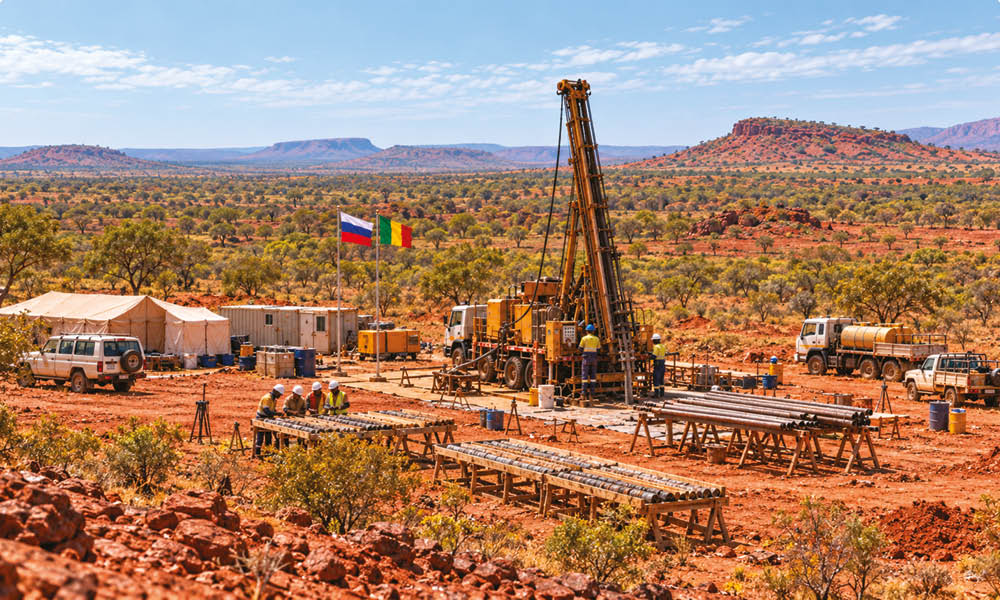
Lithium: Rosatom Envisages a New Operation in Mali from 2028
According to information communicated in late September 2026 by Rosatom, the resources of the Bougoula deposit would now reach 458,000 tonnes in lithium carbonate equivalent, an increase of 50% compared to previous estimates. These resources, still presumed, will need to be confirmed by further studies. In two years, Uranium One Group has prospected more than 200 km², carried out more than 100 drillings, and taken more than 20 kilometers of geological cores. The objective is to produce spodumene concentrate, used notably in battery manufacturing.
A Feasibility Study in 2027.
After the renewal of its exploration permit in 2024, Rosatom plans a feasibility study in 2027. If its conclusions are favorable, construction of the mining facilities could begin in 2028. The Russian group also wishes to mobilize partner investors to finance the project. With Goulamina and Bougouni already in production, Bougoula could strengthen Mali’s place in the lithium sector.
Mining Operation: Malian Government Cancels Three Large Mine Operating Permits
It is a decision that is both unprecedented and surprising in Mali’s mining sector. Three gold companies had their mining operating titles canceled by decrees of the Malian Prime Minister on September 24. After the wave of cancellation of 121 exploration titles and quarry operating authorizations in 2025, the Malian authorities are making a decision with strong symbolic scope, but also worrying for investors.
It is publicly known that the mines whose operating permits were canceled had disputes with the Malian State and experienced recurring difficulties in their operation. The mines of Tabakoto (SEMICO), Kofi, and Komana (SMK) no longer have the right to continue their activities in Mali. This decision already worries workers’ representatives, who have contacted the Ministry of Mines about the fate of the employees of these firms, whose capital is majority Ghanaian (SEMICO and Kofi) and Burkinabe (SMK).
Mali School of Mines and Petroleum: Creation Approved by the Council of Ministers
It took more than fifteen years to finally see Mali equip itself with a mining school. During its session of September 30, the Council of Ministers adopted the texts creating the School of Mines and Petroleum (EMIPE), with the mission of initial and continuing training of human resources in the fields of mines and petroleum. This creation marks a break with the vision of the authorities of the time who had, under the aegis of Prime Minister Boubou Cissé, proceeded to lay the first stone of the African School of Mines. The Transition of Army General Assimi Goïta makes the choice of a Malian school and no longer African, training in both mines and petroleum.
Ouagadougou, Capital of Mines and Energy of the AES
It was a meeting announced since the first months of the Malian presidency of the Confederation of Sahel States (AES). It took until the second year of the Confederation, under the presidency of Burkina Faso, to see a meeting dedicated to mines, energy, and hydrocarbons in the AES space. From September 14 to 19, Ouagadougou welcomed the main players in the mining, petroleum, and energy sectors of the three AES countries. The AES Energy, Mines, and Hydrocarbons Week, coupled with the eighth edition of the West African Mining Activities Week (SAMAO), was, for many observers, the first experience of direct exchange between the mining sector players of these three countries and the authorities in charge of harmonization, regulation, and promotion of mining potential. The panels, organized essentially within the framework of SAMAO, allowed for sharing the experiences of the three countries facing common challenges, even if certain questions remain pending.
The Commission in Charge of Mining Activities: Technical Committee Meets for the Second Time
As the governance body of the Commission in charge of mining activities, the Technical Committee met for the second time on Thursday, September 17, 2026. Responsible for strengthening consultation and synergy between ministerial departments, public institutions, and mining sector players, the Committee was presented with the Commission’s major files. The secretaries general of a dozen departments spoke on the technical and strategic files submitted by the Commissioner.
At the opening of the session, Commissioner Hilaire Diarra called on Committee members to examine with rigor the progress recorded. Reforms underway at the Ministry of Mines, the performance of structures such as DNPM (National Directorate of Geology and Mines), SOREM (Society for Research and Exploitation of Mineral Resources of Mali), or even ITIE-Mali (Extractive Industries Transparency Initiative in Mali) were at the heart of the discussions.
Subcontracting: Boart Longyear Passes Under Malian Flag
The Malian subsidiary of the American company Boart Longyear (BLY Mali), a mining subcontractor for the Loulo and Gounkoto mines (Barrick Gold), which had announced its judicial liquidation in April 2025, has been acquired by the Malian company SALMAMY DRILL. CEO Cheick Ahmed THERA, during the ceremony announcing this historic acquisition, outlined his vision. He wishes to expand BLY Mali’s activities and diversify its clientele in order to no longer depend solely on the Barrick group to support its operations.
This acquisition is a relief for the 180 employees of the American company who had contested the judicial liquidation process of the company at the time.
Gold Production: Syama Revises Its 2026 Projections Downward
The Australian company Resolute Mining says it is forced to revise its projections for the current year, going from 210,000 ounces of gold to a maximum of 160,000 ounces in 2026. This adjustment is explained, according to the operational update of September 21, 2026, by difficulties in transporting leading-edge equipment necessary for its plant modernization project. These delays should result in a third consecutive year of downward revision of the company’s production forecasts. Despite this and despite the projects underway in Côte d’Ivoire which are progressing well, the company reassures about its desire to make Mali an important axis of its development strategy.
Mining Permits: Mali Resumes Processing and Issuance of Renewal Titles
The resumption of processing applications for renewal of exploration and small mine operating permits, announced at the end of the latest Councils of Ministers, surprised mining sector players in Mali. Since August 21, the government has renewed about fifteen exploration permits, thus giving renewed confidence to investors. This resumption relieves professionals in geological research who, in recent years, have seen the field of possibilities and work opportunities shrink. It should be recalled that, according to data from SICAM (Integrated Mining Cadastre Management System), more than 631 permits will need to be renewed due to the long suspension of file processing operations.
Gold: Loulo-Gounkoto Avoids a Strike
A strike announced for September 28 at the Loulo-Gounkoto gold complex was avoided. Barrick Mining and the unions concluded, on September 21, 2026, a collective agreement, confirmed by management and a union representative. Employees had presented fifteen demands, notably concerning overtime pay, reimbursement of mission expenses, and the application of prior agreements. The lifting of the notice occurs as the group continues the resumption of its activities in Mali after a long period of tensions with the authorities. An important social appeasement for one of the country’s main gold complexes.