Fourou: when gold finances community development.
Located in the Kadiolo district, the rural commune of Fourou is home to the Syama gold mine, a major industrial gold site in Mali. Its industrial exploitation began in 1990. Placed under maintenance in 2001, the mine was acquired by Resolute Mining in 2004, then brought back into operation in the second half of 2008. It is now operated by the Société des mines de Syama (SOMISY), controlled by the Australian group Resolute Mining. According to the ITIE-Mali 2024 Report, the commune of Fourou received more than 600 million CFA francs in mining royalties. These resources contribute to financing public investments and improving the living conditions of the population.
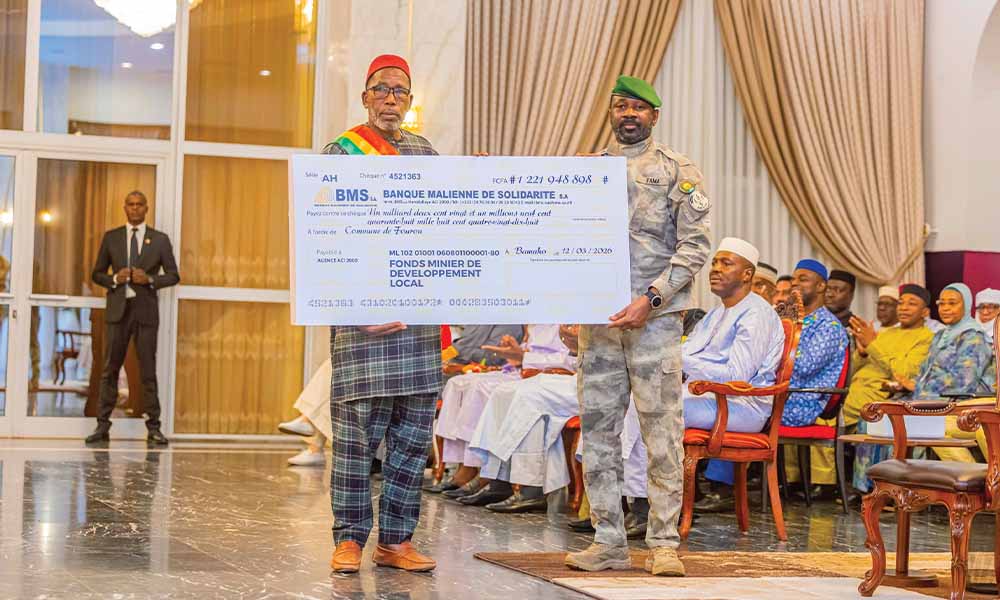
The mayor of Fourou, Ousmane Ouattara, receives from H.E. Army General Assimi GOÏTA, President of the Transition and Head of State, the check from the FMDI for his commune. Photo: Presidency of the Republic of Mali.
To understand the management mechanisms of these revenues and their impact on local development, POINT FOCUS spoke with Ousmane Ouattara, mayor of the rural commune of Fourou.
From the outset of the interview, the challenge facing a rural commune located in the immediate vicinity of a mine the size of Syama becomes apparent. Expectations are high, both toward the mining company in terms of revenue redistribution and toward local authorities tasked with translating them into concrete achievements. The Fourou town hall is trying to respond through planned investments, financed notably by mining-related revenues.
Planning the use of mining revenues.
The Fourou town hall has an Economic, Social, and Cultural Development Program (PDESC), which is its main planning tool. This document sets the commune’s development priorities for a five-year period, based on the needs expressed by the population. Revenues from mining royalties finance a large part of the investments included in this program.
According to the balance sheet presented by Ousmane Ouattara, these revenues have allowed the commune to carry out numerous infrastructures that directly contribute to the well-being of the population. The projects concern several sectors and different categories of the population.
For the 2025 fiscal year, the commune of Fourou was allocated 1,221,948,898 CFA francs from the Local Development Mining Fund (FMDL). The corresponding check was handed to its mayor on March 12, 2026, in Koulouba. For Ousmane Ouattara, these resources constitute a major opportunity to finance structuring projects and sustainably improve the living conditions of the population.
The main projects financed by mining revenues.
Invited to take stock of the investments made by his administration, the mayor mentions interventions that cover agriculture, education, health, culture, and road infrastructure.
According to information provided by the town hall, the rural commune has recently received three dams at Gouéné, Torokoro, and Kationni, for a total cost of over 300 million CFA francs. These structures retain water during the rainy season to support agricultural activities in the dry season. They thus promote market gardening development, increased production, and improved household incomes.
Mr. Ouattara adds: “We have also invested in road infrastructure and public lighting. The commune now has over 20 kilometers of roads equipped with lithium battery solar streetlights, including 35 installed in the village of Fourou. Additionally, construction work on a four-kilometer canal is underway to improve water management and irrigation.”
He continues: “The education sector also benefits from these resources. Of the 37 schools in the commune, 20 have been fenced, and all public schools have been rehabilitated, including the oldest ones. For the 2025-2026 school year, over 500 desks were distributed to schools. The commune also allocated 24 million CFA francs for the purchase of school supplies. An all-terrain vehicle was made available to the Pedagogical Animation Center (CAP), while secondary school administrations were equipped with computer hardware and electrical installations.”
In the health sector, the five community health centers (CSCOM) of the commune have been fenced and equipped with solar installations consisting of twenty panels each. The salaries of the five chief physicians as well as those of seventeen community health workers are covered by the commune. A medicalized ambulance has also been acquired to improve health evacuations.
The youth of Fourou have not been forgotten. A cultural center, costing 127 million CFA francs, was built. Several rolling equipment items have also been acquired to support youth activities. The commune also contributed to the rehabilitation of the Grand Mosque of Fourou, now powered by a modern solar installation.
An impact that extends beyond communal borders.
According to the mayor, the benefits of mining revenues also extend to the entire Kadiolo district. He cites in particular the participation of the rural commune of Fourou in the construction of the Kadiolo police station, the fencing and electrification of the tax collection center, the equipment of several administrative services, the rehabilitation of the District Council building, and the provision of computer equipment to the Kadiolo Court.
He adds: “We have also strengthened the operational capacities of several decentralized State services by providing them with vehicles to facilitate their travel and field missions.”
According to Ousmane Ouattara, these investments are part of an institutionalized dialogue that has been ongoing for several years. A consultation framework meets monthly with approximately 75 participants, under the chairmanship of the sub-prefect. Each village bordering the mine is represented by four delegates: the village chief, a councilor, a woman, and a young person. The town hall, State technical services, and mine representatives also participate in these meetings.
These exchanges make it possible to evaluate the activities carried out, identify residents’ concerns, and seek consensual solutions. The resolutions adopted are then subject to regular follow-up.
This consultation approach aligns with the approach now recommended by national authorities for the management of the Local Development Mining Fund. The mechanism provides for project monitoring at the communal, regional, and national levels.
“Mining revenues are an opportunity to accelerate development.”
“The mine has undeniably contributed to the development of our commune. Mining revenues are an opportunity to accelerate development. Numerous public infrastructures have been built thanks to mining revenues,” emphasizes Ousmane Ouattara. According to the elected official, the building housing the Fourou town hall was itself built thanks to mining resources.
Aware that a mining company cannot meet all the community’s needs, the mayor intends to preserve this partnership in the service of local development. He concludes by calling on the population to prioritize dialogue and collaboration with the mining company.
By M.C.