From Panel to Grid: How Do BESS Store and Restore Solar Energy?
Solar produces increasingly cheaper electricity. Battery Energy Storage Systems (BESS) make it possible to conserve surplus produced during the day and restore it during hours of highest demand, particularly in the evening. They thus improve the availability of this energy and its economic value. Their profitability depends on the savings achieved and the services rendered to the grid.
From Noon Sun to Evening Peak.
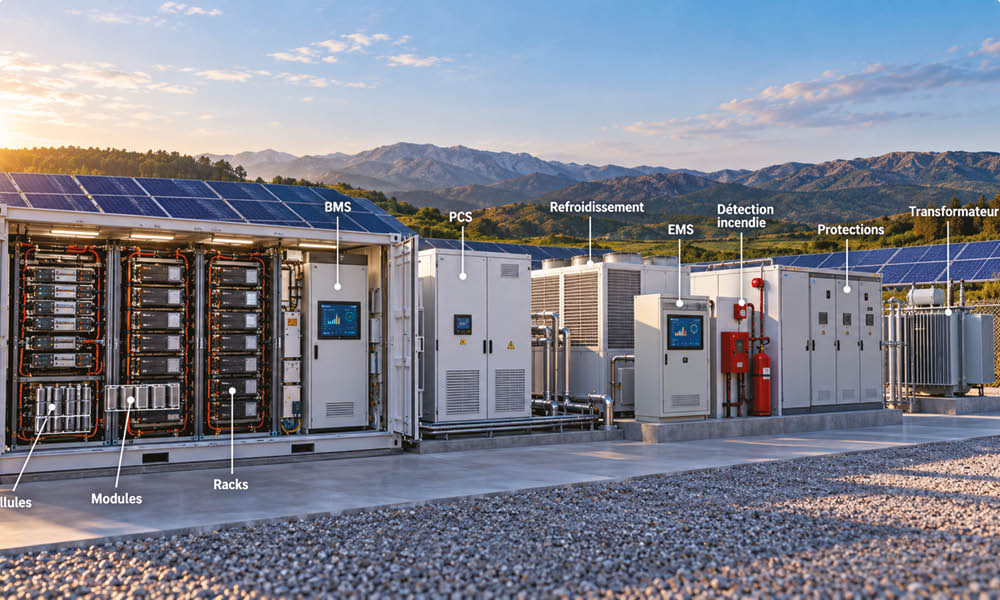
A BESS, or Battery Energy Storage System, combines several pieces of equipment. Cells are grouped into modules, then into racks installed in containers. They store electricity in chemical form before restoring it on demand. The BMS, or Battery Management System, monitors the voltage, temperature, and state of charge of the modules. The PCS, or Power Conversion System, transforms the direct current of the batteries into alternating current usable by the grid and reverses the operation during charging. The EMS, or Energy Management System, decides when to charge or restore electricity. Cooling, fire detection, transformer, and protections complete the device. Two units help understand its size. The megawatt (MW) indicates the power the system can deliver at a given moment. The megawatt-hour (MWh) measures the amount of energy it can store. A 10 MW/20 MWh BESS can therefore, in theory, supply 10 MW for two hours, before taking into account losses and safety margins. Its primary role is to shift solar electricity produced at noon to the evening peak. Its speed also allows it to correct an imbalance between production and consumption, stabilize frequency, smooth solar variations, or contribute to grid restart after a general failure. Lithium iron phosphate (LFP) technology now dominates stationary storage: it represented about 90% of new global installations in 2025. Less dense than certain chemistries intended for electric vehicles, it is less costly, suitable for frequent cycles, and more thermally stable.
Under What Conditions Does Storage Become Profitable?
The fall in prices has profoundly changed the equation. According to the International Renewable Energy Agency, the installed cost of a four-hour BESS fell to around $140 per kWh (about 80,000 F CFA/kWh) in 2025, nearly 95% less than in 2010. In China, it even fell below $70 per kWh (about 40,000 F CFA/kWh). The profitability of a storage system depends on the savings it allows and the services it provides, taking into account energy losses at each cycle. These benefits can take several forms: using solar energy produced at noon in the evening, reducing diesel use, avoiding curtailing a plant when the grid cannot absorb all its production, limiting the cost of outages, or deferring the reinforcement of a power line. The remuneration of services such as frequency regulation can complement these savings. Profitability thus relies on the combination of several uses and revenue sources, including the price difference between off-peak and peak hours. It also depends on the number of cycles, cell degradation, financing, fuel replaced, maintenance, and, in hot climates, cooling. For importing countries, exchange rate risk is added to the equation.
In Senegal, Walo Storage illustrates this logic. Commissioned in July 2025 in Bokhol, the project combines 16 MW solar with 10 MW/20 MWh lithium-ion storage. It must notably provide the National Electricity Company of Senegal (Senelec) with frequency regulation, islanding operation, and grid restart services. Its economic model relies on a twenty-year purchase contract with the national operator.
Shifting Energy Remains Difficult to Make Profitable in Mali.
Mali is directly concerned. The regional BEST project, Battery Energy Storage Technology, supported by the World Bank, plans for EDM-SA (Énergie du Mali – Société Anonyme) the installation of 80 MWh of storage and synchronization equipment. A study by the West African Power Pool (WAPP), the West African electricity exchange system, however, shows that shifting energy alone remains difficult to make profitable in Mali in its 2025 scenarios. Prospects become more favorable by 2030 but remain very sensitive to equipment costs, discount rates, and fuel prices. As solar plants multiply, BESS become a tool for managing the electricity grid. They make it possible to shift energy over time, stabilize supply, and facilitate the integration of new photovoltaic capacities. Their development will depend on the profitability of these services over the entire lifespan of the installations.
Author: T.Z.