Solar on Credit: How Does Pay-As-You-Go Work?
In Africa, the cost of a solar installation remains out of reach for many households. Pay-as-you-go (PAYGo), literally “pay as you go,” offers a solution based on installment payments, generally by mobile phone. Already well established in several African countries, this model contributes to the rise of a new energy market.
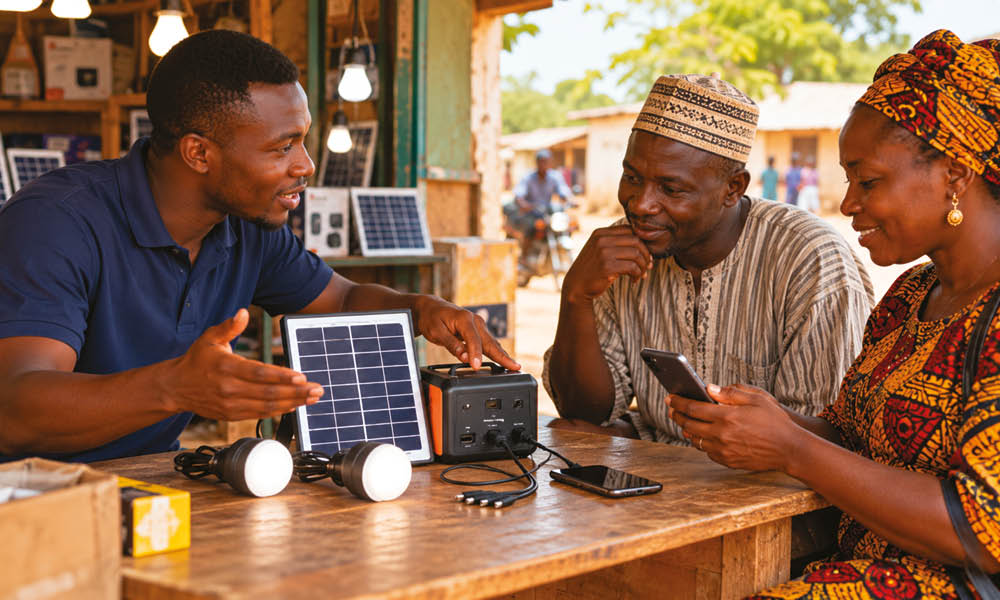
The principle is simple: the customer pays a down payment to obtain a solar kit generally including a panel, a battery, and lighting or charging equipment. They then pay small sums, daily, weekly, or monthly, most often via mobile money. The device includes an electronic system allowing the supplier to manage its operation remotely. Depending on the contract, a late payment can result in a temporary suspension of power. Once all installments are paid, the customer becomes the owner of their equipment.
Kenya is a pioneer. Companies like M-KOPA have popularized this model there, notably thanks to the development of M-Pesa mobile payment. In West Africa, ENGIE Energy Access also markets solar kits in installments in Benin, with the support of international financial partners.
The market is experiencing rapid growth. According to the professional association GOGLA, sales of pay-as-you-go solar kits grew by 54% in sub-Saharan Africa in the first half of 2025, reaching 2.35 million units among reporting companies. This formula nevertheless has constraints. The total cost may exceed that of a cash purchase, and installments must remain compatible with household incomes. A study published by GOGLA in 2025 reveals significant repayment difficulties among customers in Kenya and Uganda. In Mali, where a few offers are beginning to appear, this model could facilitate the equipping of households and small shops. Its development will depend notably on the transparency of contracts, the reliability of equipment, and the existence of a true after-sales service.
Author: T.Z.