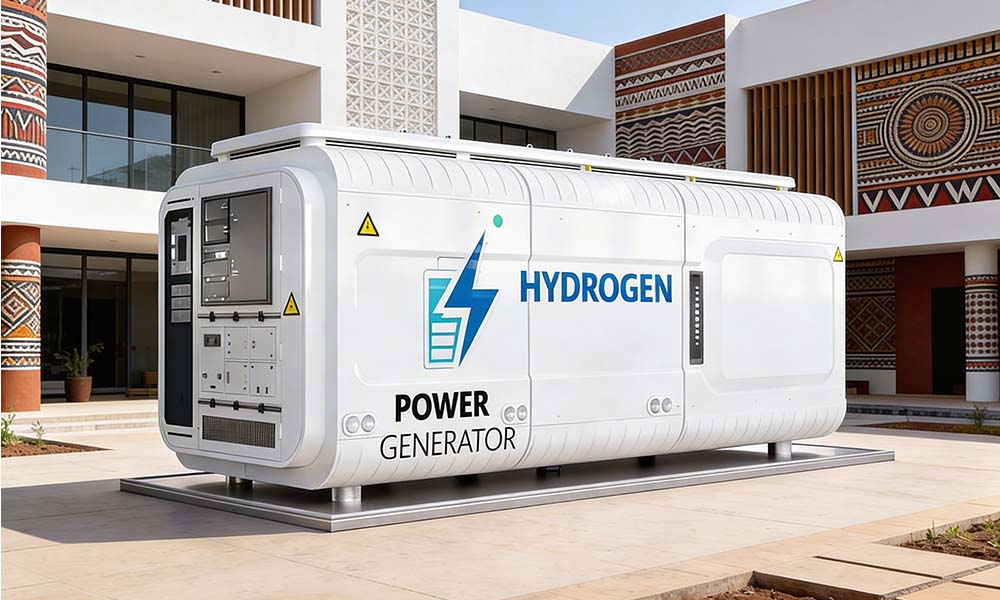
Hydrogen generator set: how it works, and where the transition to reality begins
Mali is regularly cited when it comes to natural hydrogen, notably through Bourakébougou and the ambitions displayed around this resource. But one simple question remains: what can hydrogen already be used for concretely in electricity production? The answer lies in equipment still little known to the general public: the hydrogen generator set.
In its most common form, this type of system relies on a fuel cell. The principle is simple: stored hydrogen is injected into a device where it reacts with oxygen from the air to produce electricity. At the point of use, the emission is essentially water and heat.
It is therefore an electrochemical system capable of directly transforming gas energy into electrical current. In other cases, closer to the logic of conventional generator sets, hydrogen can also be used in an engine adapted to its combustion.
● Still far from mainstream equipment.
On the international market, these devices already exist but remain concentrated on power levels still limited compared to the most common diesel standards. Small mobile models are often between a few kilovolt-amperes and 8 kVA, while stationary or more robust solutions generally range from 50 to 130 kVA, with some equipment reaching up to 200 kVA. Price-wise, orders of magnitude remain high: a few thousand to a few tens of thousands of euros for small mobile formats, and several tens to several hundred thousand euros for more powerful stationary systems. Hydrogen thus remains far from commonplace mainstream equipment. Concretely, the “fuel” does not present itself as a liquid poured into a tank, like diesel. Most often, hydrogen is stored as compressed gas in cylinders, cylinder frames or high-pressure tanks connected to the machine. It can also be stored as a liquid, but this option requires extremely low temperatures and is much heavier to manage. In the most realistic uses today for a generator set, gaseous storage under pressure dominates.
● A technical but also logistical subject.
Technical in its operation, logistical in its implementation, the hydrogen generator set, like any machine, depends on consumables. The gas must be transported, stored safely, and then the containers replaced or recharged according to consumption. Even today, this distribution and storage chain remains cumbersome to organize. Hydrogen thus remains largely produced and consumed on site, with little large-scale transport, as the necessary infrastructure remains costly and complex.
● Transforming a Malian singularity into concrete solutions.
This is what makes the Malian case particularly interesting. The country can be cited as a significant emerging actor in hydrogen, but the future will be determined by visible use. In a context of persistent energy crisis, having a resource is not enough in itself. This singularity must still be transformed into concrete solutions: backup power, isolated sites, hybrid systems or, tomorrow perhaps, more widely distributed electricity production.
For Mali, the challenge now would be to transform its hydrogen potential into concrete energy solutions, with professional and collective outlets first, before wider distribution to certain residential uses.
T.Z.