Solar Energy: Fashion Trend or a True Revolution in Consumption Habits?
In March 2025, in an interview with our colleagues at APnews, Brice Bado, marketing manager of WeLight in Mali, an operator specializing in rural electrification via solar mini-grids, proudly announced: “We started gradually with 40 customers in 2021 and today we have more than 200.” This statement gives the measure of the new electricity market taking shape. It is not uncommon to see photovoltaic panels on the roofs of small shops in Mali’s major cities, illustrating how solar is gradually blurring the boundaries between producer, supplier, and consumer. A new energy consumption model is gradually settling into habits, in a Mali facing an unprecedented energy crisis, pushing analysts to wonder whether solar can transform the electricity economy in Mali.
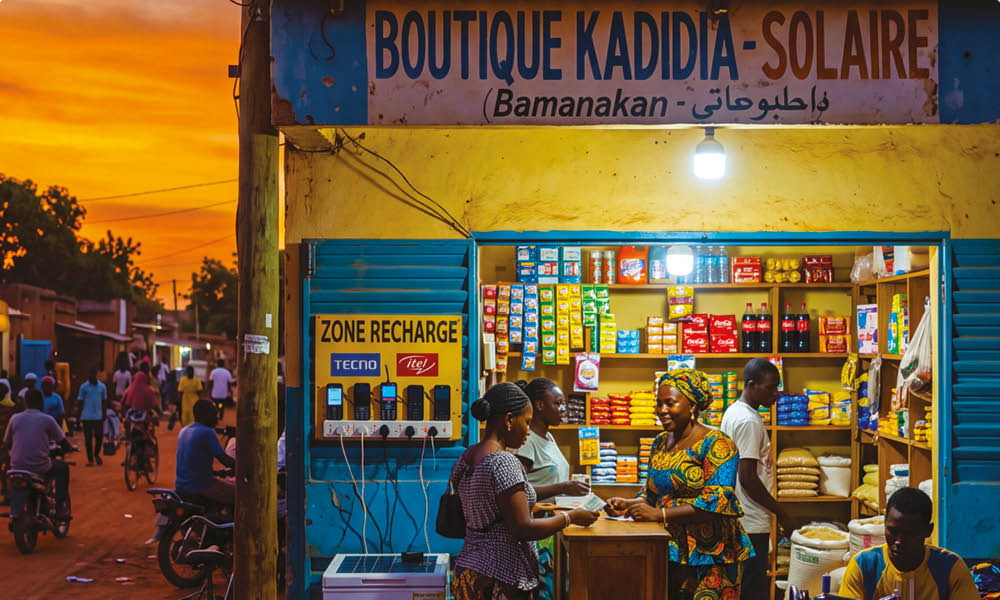
Araouna Traoré, a tailor in Yirimadio, sums up in one sentence his despair and incomprehension in the face of the all-too-regular and prolonged absence of electricity: “And yet, we have the sun.” To overcome this difficulty, he had a solar device from a Turkish brand installed so he could continue practicing his trade and honor his commitments and deadlines. This installation of a “200 gel battery,” as he calls it, turned out to be a particularly happy investment that allows him to benefit from the potential of solar energy. His case is, however, symptomatic of a change in consumption patterns and, implicitly, in electricity production patterns in Mali. Nearby small shops, vying with each other, are equipping themselves with solar panels and devices combining panels and batteries, adapted to their immediate needs. Others opt for equipment—bulbs, fans, or others—that recharge directly from photovoltaics. From panels on the roofs of individuals and small shops to the large photovoltaic power plants announced by national authorities, Mali is changing its energy model. Its energy mix, which has included since May 2024 a projection of 350 MW of solar energy, with the mega-projects of Sanankoroba (200 MW), Tiakadougou (50 MW), and Fana (100 MW), thus carries a promise of energy sovereignty with a little more than 15% of total production shifting to photovoltaics. These strategic choices, however, favor the creation of a new ecosystem with new players seeking to profit from this new consumption model, favored both by the abundance of solar resources and by the difficulties of the national company Énergie du Mali (EDM-SA) in ensuring a continuous supply of electricity across the entire territory. Between financing, storage techniques and technologies, jobs, and imports, a true new “solar economy” is settling in and taking shape.
Solar: Safe Haven or Safe Value?
The 398.7 GW of technically exploitable photovoltaic potential on the territory, identified by the International Renewable Energy Agency (IRENA), prove that solar has the means to impose itself as a safe haven during this crisis of electricity supply. It has imposed itself as an alternative to load-shedding and the operating cost of generators, particularly during fuel shortages. Both affordable for small domestic installations and costly as soon as sizing requires a large storage capacity, solar tends to become more of a safe value. A safe value, as much for consumers as for the economy being created around it. It has been observed that, in recent years, Mali has hosted a multitude of companies offering solar engineering services, from technical study to installation, including maintenance and repair. These companies, both national and foreign, have spotted the economic niche being created around solar. In less than three years, the backup solution has become an essential option. Where generators have remained an essentially temporary solution, photovoltaics has become the serious alternative to the vagaries of state energy distribution. Malian entrepreneur Samba Bathily had quickly understood the potential of solar for our countries, he who, as early as 2014, created Solektra International, a company specializing in the supply of solar energy and water technologies for infrastructure development in Africa. With the iconic figure of American music Akon, Solektra International launched several avant-garde projects in Mali. First, a Solar Academy (Solektra Solar Academy), created in 2016 with the objective, according to its founder in the columns of Afrikmap, “to stem the energy crisis that Africa has been going through for several years now.” Then, in 2017, the inauguration of an assembly line with a production capacity of 30,000 solar street lamps in Bamako by the artist Akon, partner of Samba Bathily.
Mini-Grids and the New Economy.
Samba Bathily’s example has multiplied across Malian territory. Companies such as Afrilight, Neutron, Green Energy, and Suncom have emerged with the ambition to reduce the gap in access to electricity first and foremost and to energy in a broader context. Presenting this market as entirely new would, however, not do justice to the efforts made by the State of Mali for two decades to bet on solar resources to supply remote regions and rural areas. Solar mini-grids are therefore the beginning of this market that is consolidating today. The principle was then simple: produce electricity as close as possible to those who consume it, rather than systematically depending on a long chain of production, transport, and distribution. In rural areas and localities far from the interconnected grid, the solar mini-grid thus appears as a response to the urgency of ensuring better territorial coverage of access to electricity. Mali already has significant experience in this area. Rural electrification operators have, for several years, developed isolated networks, notably under the supervision of AMADER. But the arrival of photovoltaics and batteries is gradually changing the nature of these installations. The generator, long at the heart of rural mini-grids, can now be replaced or supplemented by solar and storage. Experiences such as those of Yeelen Kura show that the model can provide electricity to households, but also to businesses and local economic activities. In a study carried out by this Malian company specializing in rural electrification through solar energy, the contribution of the 14 mini-grids installed in the regions of Sikasso, Ségou, and Koulikoro to improving the living conditions of populations is considerable. We discover that, thanks to solar, for example, “village CSCOMs have their own solar installations […] to operate certain electrical devices (sterilizer and steam extractor) to improve their services,” “Students devote more time to learning: they have more opportunities to learn at night at home, from the lighting of neighbors or public street lamps.” This report notes above all that, thanks to solar, an increase in the number of small businesses in villages has been observed. According to the study’s authors, “some small shops are developing within households around the sale of fresh products, and there is a diversification of activities of already established VSEs.” The work devoted to the potential of mini-grids in Mali is particularly revealing. A study supported by UNDP in May 2023 estimates that nearly 3.9 million people, or 21% of the population without access to electricity, could be served by this type of solution. The solution goes beyond social or humanitarian to become economic. National policies thus push for the use of mini-grids to make electricity a tool of production. Powering a solar pump, a welding workshop, an agricultural processing unit, a health center, a cold room, or a shop means supporting local economic players. At the national level, these combined productions contribute, despite the crisis, to supporting Mali’s GDP.
A Consumer Who Produces Energy.
For a long time, the Malian electricity consumer was at the end of the chain. A power plant produced, the grid transported, the distributor sold, and the customer consumed. With solar, this boundary is gradually blurring, as recalled by Diadié Sankaré, CEO of SAER Group, in issue 6 of POINT FOCUS. The shopkeeper who installs a few panels on his roof produces part of the electricity he consumes. The one who adds a battery can store the energy produced during the day and use it in the evening. A company can reduce its use of the grid or the generator. A farm can produce the electricity needed to pump its water. We now have the example of administrative or industrial buildings operating off-grid, i.e., outside the EDM-SA network, such as the building of Malian entrepreneur Ibrahim Diawara or the Azalaï Salam hotel in Bamako. This evolution now raises a question: how to organize a market in which several thousand, or even tomorrow several hundred thousand, players produce part of their own electricity? Faced with the national company, holder of the distribution monopoly, this question goes beyond mere technical consideration. Electricity demand in Mali is growing strongly, and decentralized solutions—such as small units, mini-grids, self-production, and energy services—can meet part of this growth. But at what cost to Énergie du Mali, the national company? The role of the State and the regulator will then be to find the right balance between freedom to invest, consumer protection, and grid stability. Domestic and commercial solar must not create an anarchic market where the quality of equipment, the safety of installations, or the conditions of electricity sales would be left to chance.
Sovereignty and Energy Dependency?
In his introductory speech at the first meeting of ministers in charge of Energy, Mines, Quarries, and Petroleum of the Confederation of Sahel States (AES), held in Ouagadougou on August 13, 2026, the Prime Minister of Burkina Faso, Rintalba Jean Emmanuel Ouédraogo, argued that “in the fight for the true emancipation of populations and the full and entire sovereignty of [the] AES Confederation, energy occupies a highly strategic position.” Applied to solar energy as it is produced today, this discourse raises questions. Are our countries truly sovereign? The promise of energy sovereignty must be viewed with caution. Indeed, the sun is Malian, and the energy produced by the panel installed in Yirimadio is produced in Mali. But the panel, the inverter, the battery, and a large part of the equipment that makes it possible to transform this light into electricity still come from abroad. There is therefore a legitimate fear that, despite the political discourse, our country is only changing the nature of its dependency. Yesterday, Mali depended heavily on imported hydrocarbons to run part of its thermal power plants. Tomorrow, it could reduce this dependence on fuel while remaining dependent on imported equipment necessary for the production and storage of electricity. China occupies a central place in global manufacturing chains for photovoltaic equipment and batteries (Editor’s note: see article page 12). Mali’s challenge is therefore not to close the door to imports, but to transform this dependency into an industrial opportunity. It is at this level that Mali can play the lithium card as a producer of spodumene. Malian authorities, the Minister of Finance first and foremost, recall that the ultimate objective is to succeed in transforming raw materials such as lithium spodumene in Mali.
A True Value Creation Policy.
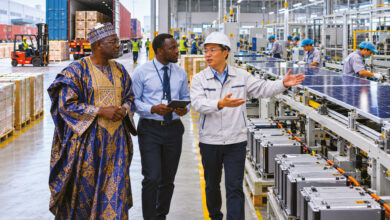
The Minister of State, Minister of Economy and Finance, Alousséni Sanou, thus displayed the ambition to see Mali have a battery manufacturing unit within the next three years. This unit will complement the solar panel production plant of the Malian company Diapar Solar, located in Kati, 15 km from Bamako. All in all, the State and private players will need to think about a true value creation policy around solar potential and lithium reserves. The real challenge of the coming years is therefore to master a constantly evolving market, because solar has entered habits, investments, and public strategies. This policy could, from now on, begin with subsidy mechanisms facilitating access to solar equipment.
Author: Baba Sakho