Is China the Big Winner of the African Solar Boom?
In 2025, Chinese exports of photovoltaic panels to Africa reached 18.8 GW, compared to 12.7 GW a year earlier, a 48% increase. Having become a major market, the continent now raises an economic question: who captures the value of this growth? China very largely dominates the industry that supplies the African solar boom. It has also contributed, through its prices and production capacities, to making it possible.
Africa Becomes a Strategic Market.
The movement is no longer limited to South Africa. In 2025, Egypt imported the equivalent of 2.3 GW of panels from China, compared to 1 GW in 2024. Algeria went from 0.35 to 2.1 GW. Behind these volumes are large grid-connected power plants, but also a multitude of systems that are harder to account for: corporate rooftops, mining installations, shops, workshops, farms, mini-grids, and household equipment. These shipped volumes correspond neither to the installations completed during the year nor to the electricity actually produced. They nevertheless reveal the depth of demand. In June 2026, while Chinese solar exports were declining globally by 9% year-on-year, shipments of cells and panels to Africa were still growing by 26%, to 103,277 tonnes.
China Does Not Only Supply Panels.
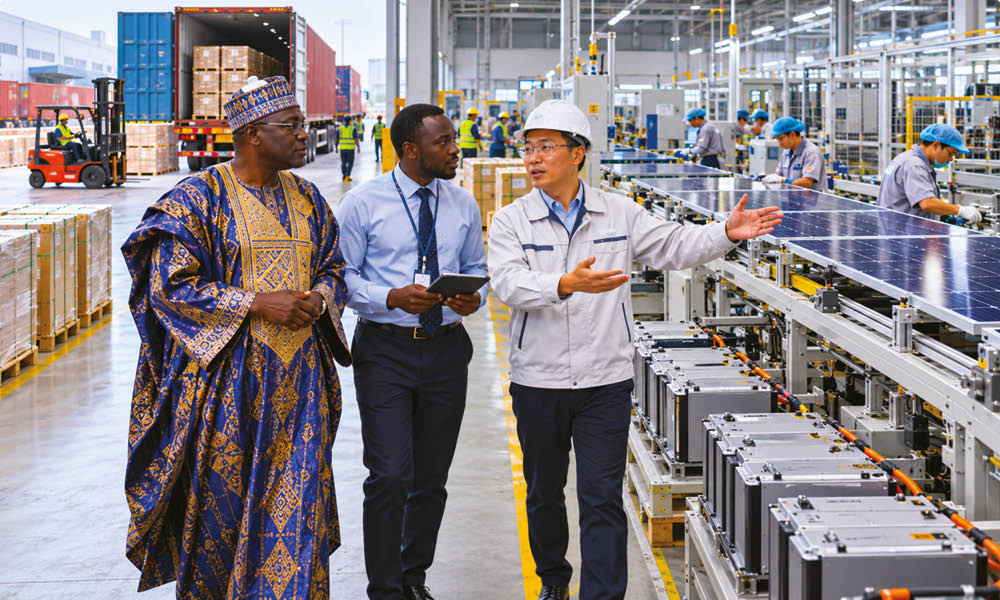
China’s weight begins well before the assembly of the final module. Polysilicon is transformed into ingots, cut into wafers, then converted into cells that are assembled into a panel. According to the International Energy Agency, China concentrated in 2024 about 85% of the world’s solar chain production capacities, with a share reaching 95% for wafers. It also supplied about 80% of global module demand and 90% of upstream components, notably wafers and polysilicon. Added to this is a lithium-ion battery industry of which China represents about 80% of global capacities. Even when a panel is assembled or installed in Africa, a decisive part of its industrial value has therefore often already been created in China. Assembling imported cells, manufacturing a module, and producing the cells themselves correspond to three very different industrial levels.
Chinese Prices Made the Boom Possible.
This domination does not only explain the origin of the equipment. It also explains their accessibility. After a massive expansion of Chinese capacities and very fierce competition between manufacturers, the price of modules fell to as low as $0.07 per watt (about 40 F CFA) in 2025, compared to about $0.25 (nearly 150 F CFA) in 2022. These values concern the module, excluding transport, taxes, inverter, battery, structures, and installation. The decline does not result from a single factor. It combines economies of scale, technological progress, improved yields, automation, and industrial overcapacities. It opened the market to businesses and households that could not previously amortize a solar installation. But it also compressed the margins of Chinese manufacturers and caused heavy losses. China therefore gained in volume, influence, and market share without all its companies necessarily making money.
A Dependency Revealed by a Decision Made in Beijing.
On April 1, 2026, China removed the VAT refund granted to exports of photovoltaic products. The rate applicable to batteries was reduced from 9% to 6% until the end of 2026, before an announced removal on January 1, 2027. A Chinese tax decision can therefore modify the economics of a project studied in Bamako, Lagos, or Lusaka. A price indicator cited by the Financial Times rose from $0.09/W (about 50 F CFA/W) in December 2025 to $0.114/W (nearly 70 F CFA/W) in mid-April 2026. The tax reform does not explain everything: Beijing’s desire to curb destructive competition, the price of silver metal, and other costs also played a role. African demand nevertheless resisted, as shown by June 2026 shipments.
China Also Wins on Large Projects.
Chinese companies do not just sell equipment. They intervene as engineering firms, builders, and sometimes investors. Africa already represents about 30% of PowerChina’s international turnover, which aims for 40 to 45% by 2030. In South Africa, the group participates in some $3.5 billion (about 2,050 billion F CFA) of renewable projects. In Zambia, the Chisamba solar plant, built by PowerChina and inaugurated in June 2025, develops 100 MW. It supplies the mining group First Quantum Minerals and, according to Zambian authorities, frees up capacity that can serve other consumers. This type of project shows where another part of the value lies: studies, engineering, supply, construction, commissioning, and long-term contracts.
Africa Largely Gets Its Share.
The observation is not, however, that of a continent reduced to the role of buyer. Cheaper equipment makes it possible to reduce diesel use, secure a company’s production, electrify an isolated site, or extend access to electricity more quickly. In 2025, GOGLA member companies sold more than 10 million off-grid solar kits worldwide. Sales grew by 26% in West Africa, mainly driven by the Nigerian market. A local economy is also developing around import, distribution, sizing, installation, financing, maintenance, and operation. IRENA emphasizes that, outside major producing countries, photovoltaic jobs are concentrated precisely in construction, installation, operation, and maintenance rather than in manufacturing. The value captured is therefore different, but it is not negligible.
Focus on Mali.
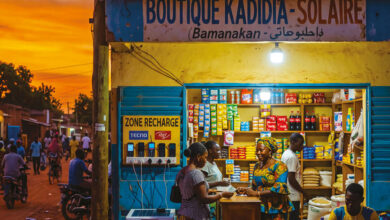
In Mali, the rise of solar is now visible on rooftops as much as in power plant projects. Long periods of load-shedding have pushed many households, shops, and small businesses to seek their own energy solution. Panels, inverters, and batteries have gradually become common equipment, intended not only to ensure lighting but also to run refrigerators, air conditioners, pumps, computer equipment, or production tools. This demand has given rise to an entire market. Importers, traders, electricians, installers, and maintenance workers have invested in a sector that has become particularly promising. The fall in the price of Chinese equipment largely made this movement possible, offering solutions accessible to categories of customers who previously could only rely on a generator or suffer outages. This rapid growth, however, has its downside. The quality of materials remains very uneven, the announced powers do not always correspond to actual performance, and some installations are carried out without serious sizing. The development of the market thus creates as many needs for equipment as for skills, control, maintenance, and after-sales service. Malian companies such as Horonya Solar and Diapa Solar are trying to develop local production. The first specializes in the manufacture and distribution of solar panels, as well as their installation and maintenance. The second has a photovoltaic panel manufacturing unit in Kambila, near Kati, and also offers solar solutions for households and businesses. But in the immediate term, the bulk of Mali’s solar economy still relies on the sale, installation, and maintenance of equipment whose main components come from abroad, and very largely from China.
Author: Toumani Zerbo